ANY-maze Help > The ANY-maze reference > The Protocol page > The elements of a protocol > Behaviour > Sequences > Setting up a sequence > Specifying the characteristics of a sequence
Specifying the characteristics of a sequence

In brief
There are four characteristics which you can apply to a sequence by checking appropriate buttons on the sequence's settings page:
| 1. | Sequence can be performed in either direction: The steps of the sequence can be performed either from the first step to the last or from the last to the first. |
| 2. | Sequence can start at any step: The sequence is treated as a circular series of steps, where the last step leads back to the first. You can also optionally specify whether the animal must explicitly return to the starting step to complete the sequence. For example, in a sequence with four steps in which the animal must return to the first step, then the sequence could be completed by moving from step 1 > 2 > 3 > 4 > 1, or by moving from steps 3 > 4 > 1 > 2 > 3. You can specify that a sequence is both a sequence which can start at any step and a sequence which can be performed in either direction. |
| 3. | Sequence is not broken by moves to positions which are not in any step: Ordinarily, if the animal moves to a position which is not inside any of the sequence steps, then the sequence is broken. For example if sequence is 1 > 2 > 3 and the animal moves 1 > 2 > ? > 3 (where '?' means a position that's not in step 1, 2 or 3) then the sequence would normally be broken. You can use this option to change this, so that in the example the sequence would still be scored. |
| 4. | The steps can be performed in any order but no step can be repeated. This type of sequence allows you to detect single visits to a number of different areas or zones. |
Details
Sequence can be performed in either direction
Imagine a situation where you want to detect crossings between the two sides of a place preference box where the sides are connected with a tunnel. In this situation, you could use a sequence of 'Left side > Tunnel > Right side' to detect such an event. However, you'd be equally interested in a sequence of 'Right side > Tunnel > Left side', and it's this reversal of the sequence's direction which is controlled by this characteristic.
Sequence can start at any step
Imagine a situation where you want to detect rotations around a water-maze. This could be done by defining a sequence like the one shown in figure 1. Here the animal would have to move from one step to another to complete the sequence, but it wouldn't actually matter where the animal started the sequence, provided it went through all the steps. For example, a sequence which ran through steps 3,4,5,6,7,8,1,2 would be just as valid as one which ran from 1 to 8.
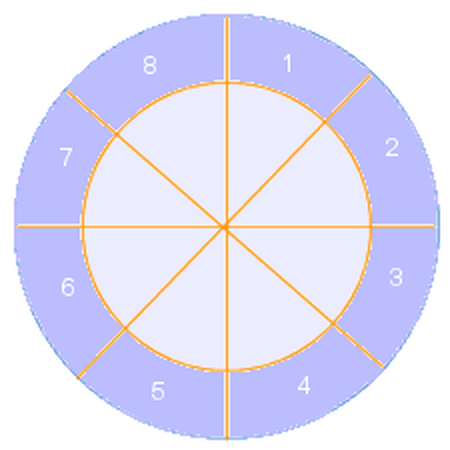
Figure 1. By moving through the numbered steps, the animal will complete a rotation around the water-maze, but it won't matter which step it starts in.
In fact, things are a little more complicated because if the animal starts, for example, in step 1 and works its way round to step 8, it won't actually have completed an entire rotation - see figure 2.
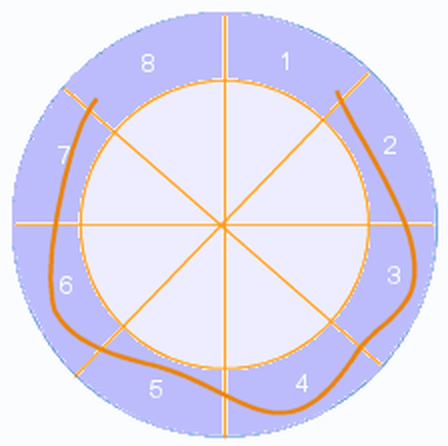
Figure 2. In fact, just moving into the correct area for each step won't necessarily complete a sequence. Here the animals track moves through all the steps from 1 to 8 but the animal hasn't actually completed a rotation.
This could normally be resolved by specifying the first step again at the end of the sequence, but in a sequence which can start at any step you don't actually know which will be the first step. ANY-maze resolves this by providing an option to close a 'Start at any step' sequence for you, by requiring the animal to return to the starting step. Thus in the water-maze example, if the animal started at step 5, it would need to proceed as follows: 5 > 6 > 7 > 8 > 1 > 2 > 3 > 4 > 5 to complete the sequence; ANY-maze would automatically have closed the sequence by adding step 5 onto the end - see figure 3.
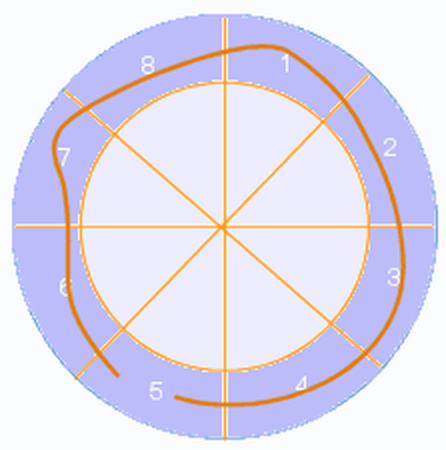
Figure 3. By requiring the animal to return to the first step, a complete rotation is created.
If you wish, you can specify that the sequence ends when the animal enters the final step (rather than having to 'close' the sequence). In this case, after completing the sequence ANY-maze will wait until the animal moves to another step before it starts checking for the next sequence. For example, consider a Y-maze sequence with three steps A,B,C; in this case, the animal might perform the following steps BCABCA; here ANY-maze would consider BCA as completing a sequence and would then wait for the next move (so the move from A to B) before starting the next sequence - which would then be BCA again. Contrast this to what would happen if ANY-maze did not wait for a move; in that case, the first sequence would end after BCA and the system would then start the next sequence at A and this would complete after the moves to B and C - in other words the move to A would be both the end step of one sequence and the start step of the following sequence.
In summary, when you specify a sequence that can start at any step, you need to choose whether the sequence requires the animal to return to the start step (in which case the move to the start step will both end one sequence and start the next one), or whether the sequence ends when the animal moves to the last step (in which case, the system waits for a move to another step before starting the next sequence).
By the way, it's often useful to mix the Sequence can start at any step characteristic with the bi-directional characteristic - in the water-maze example, this would count a rotation whether it was performed clockwise or anti-clockwise.
Sequence is not broken by moves to positions which are not in any step
Sequences which are not defined as The steps can be performed in any order but no step can be repeated require the animal to move through a certain sequence of steps, for example 1 > 2 > 3 > 4. So, when at step 2 the animal must move on to step 3, otherwise it will break the sequence.
But the steps are defined as areas in the apparatus, and there may be areas which are not in any of the steps at all - so what if the animal moves into one of these areas; does that break the sequence? Usually the answer is yes - a move to an area which is not part of any step does break the sequence - but you can use this option to change this.
A good example of when this is useful is the Y-maze. Typically, the Y-maze is defined something like figure 4, i.e. with an area in the centre which is not part of any arm. So, if you wanted to know if the animal moved from arm A > B > C you would have a problem, because to get from A > B it would have to pass through the centre and that's not part of any step, so moving there would break the sequence. By using this option you could resolve this, so a move from A > centre > B > centre > C would be scored as a sequence completion.
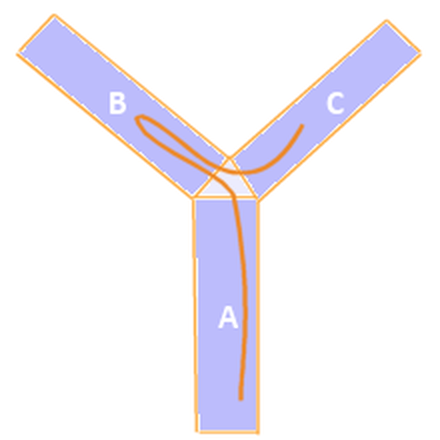
Figure 4. To score the sequence A>B>C, it would be necessary to select the option Sequence is not broken by moves to positions which are not in any step, because to move from step to step the animal must pass through the centre, which is not part of any of the steps.
A final point to understand is that the move into 'nowhere' is registered by the sequence analysis, such that a move from A into nowhere and then back into A, would break the sequence because once the animal has left A it must move into B, even if it passes through 'nowhere' in order to arrive there.
The steps can be performed in any order but no step can be repeated
Sequences which have this characteristic are called non-return sequences in ANY-maze. As this name implies, the animal can't return to a step it has already completed. This is, in fact, the only condition of such a sequence. This means that the animal doesn't have to proceed through the steps in order, nor will moving into an area which isn't part of a step break the sequence. The only thing which will break the sequence is returning to the area of a step which has already been visited.
This characteristic can't be used with a bi-directional sequence or a sequence which can start at any step.

© Copyright 2003-2026 Stoelting Co. All rights reserved
ANY-maze help topic T0352