ANY-maze Help > The ANY-maze reference > The I/O page > Making I/O connections > Connecting photobeams and nose-poke holes
Connecting photobeams and nose-poke holes

Details
Photobeams usually consist of an infra-red LED (the emitter) and an infra-red detector. These are arranged so that the LED shines a beam of light onto the detector. When the animal breaks the beam, the light no longer reaches the detector, and this is sensed by the I/O device.
Nose-poke holes are generally just small holes with a photobeam pre-installed across them, so when the animal pokes its nose into the hole, the beam is broken.
The ANY-maze Digital interface photobeam ports can be connected directly to a photobeam made specifically for AMi. In fact, photobeams from other manufacturers may also work, but you should contact ANY-maze Support and ask us to check this for you, before making such a connection.
Connecting a photobeam to a GPIO port is very easy - you simply have to connect the LED to pins 1 and 2 and the detector to pins 3 and 4 - see figure 1 below.
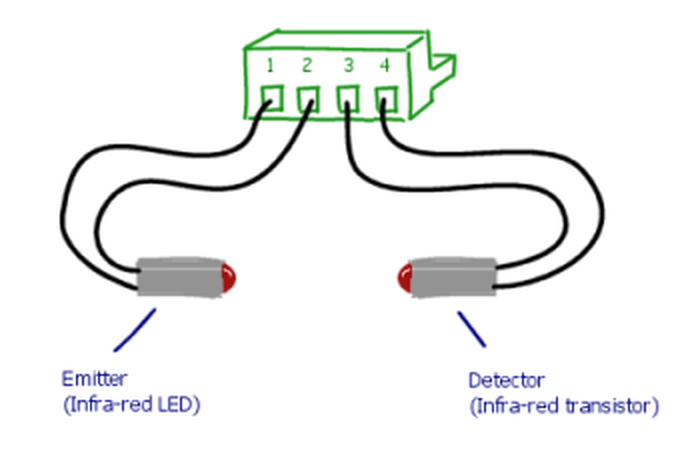
Figure 1. A photobeam connected to an ANY-maze Digital interface photobeam port.
The LED needs to be connected the right way round in order to work, specifically you should connect the cathode of the LED to pin 1 and the anode to pin 2. If you connect the LED backwards it won't be damaged, it just won't work, so if you're not sure how to connect it, try one way and then try the other.
The photobeam detector is an infra-red photo-transistor and, again, it has to be connected the right way round; in this case the collector connects to pin 3 and the emitter to pin 4. Like the LED, connecting the detector the wrong way round won't damage it, it just won't work - so if you're not sure which way round to connect it try one way and then try the other.
After connecting the beam, you will need to configure the ANY-maze Digital interface so that it knows that the port you've connected to is being used for a photobeam. You should then test that the beam is working correctly using the I/O page.
To actually use the photobeam in an experiment, you'll need to add it to the protocol as an on/off input.
See also:
| • | The ANY-maze Digital interface |
| • | The ANY-maze Digital interface photobeam ports |
| • | Configuring the ANY-maze Digital interface |
| • | An introduction to on/off inputs |

© Copyright 2003-2026 Stoelting Co. All rights reserved
ANY-maze help topic T0900