ANY-maze Help > The ANY-maze reference > The Protocol page > The elements of a protocol > Testing > Stages > An introduction to stages
An introduction to stages

Introduction
Stages are used in ANY-maze to define the tests which will be performed in an experiment, and as such they are a fundamental protocol element - in other words, all protocols must include at least one stage. In fact, ANY-maze automatically includes a First stage in all new protocols for you.
Each stage in an experiment consists of one or more trials; for example, in a water-maze you might have a 'Training' stage consisting of 4 trials, and a 'Probe' stage consisting of 1 trial. Of course, in a simple case such as a plusmaze, you would probably have just a single stage consisting of a single trial.
| • | Dividing an experiment into stages |
| • | Test duration and ending tests |
| • | The number of trials in a stage |
| • | Specifying the testing order |
| • | Specifying the position of movable zones |
| • | Working with multiple apparatus |
Dividing an experiment into stages
Although the division of an experiment into stages will usually be very obvious, the formal definition of a stage from ANY-maze's point of view is that the trials in a single stage all have the same characteristics. This means, amongst other things, that they all have the same duration and they share the same procedures. Although this defines situations in which you are required to divide an experiment into different stages, there's nothing to stop you creating two or more stages with the same characteristics if this is more logical in your experiment. For example, if in a water-maze the four 'Training' and one 'Probe' test are all 5 minutes long and if they will always end if the animal finds the water-maze island, then, technically, you could define a single stage consisting of five trials - nevertheless, it would probably be more logical for you to think of the experiment as having two stages.
Test duration and ending tests
Part of the definition of a stage is the duration of its tests. ANY-maze uses this information to time each test while it's running and to automatically end the test when the time is up. However, in some experiments, you may wish to end tests before this if the animal achieves some goal. For example, in a water-maze you would probably end the test if the animal finds the island.
As you may know, ANY-maze allows you to define procedures, which can be used to perform actions, some of which can cause the test to end. For example, in the water-maze you would probably want to include a procedure which would wait until the animal enters the island zone and then perform an action to end the test.
The number of trials in a stage
First a note about terminology: In ANY-maze the term test is a generic name which equates to what you would intuitively expect a test to be - i.e. an animal being placed in the apparatus, being tracked, and being removed from the apparatus. A trial on the other hand, is a single test within a stage. Thus, for example, ANY-maze will refer to 'Training stage, trial 1' and all the animals in the experiment will have this trial.
The maximum number of trials in a stage is part of the stage's definition, and can be any number from 1 to 100. However, you can also define stage end rules which can end the stage for an individual animal before it's had this number of trials.
For example, in a water-maze, you might want to train the animals to find the island - perhaps using the condition that they have to find the island within 30 seconds in two consecutive trials as a definition of 'trained'. This, then, would be your stage end rule. Therefore, although your stage might consist of a maximum of 6 trials, the actual number of trials an animal would receive would depend on how quickly it achieve the 'trained' condition - for example, for some animals this might be after 4 trials, while for others it might be after 5 or even 6 trials.
ANY-maze can even automatically retire animals which don't achieve the 'trained' condition within the maximum number of trials - a retired animal won't proceed on to the next stage in the experiment.
Specifying the testing order
Unless you choose to manually schedule your tests, then the stages will define the order in which the animals in an experiment will be tested.
The first fundamental of test order is that the animals in an experiment are numbered and animal 1 will be tested before animal 2. Nevertheless, there are still a number of options available to you.
In most experiments, you will probably want to perform the first stage for all the animals before proceeding on to the second stage. In the water-maze example, you would probably complete the Training stage for all the animals before starting the Probe stage. Nevertheless, there may be cases when don't want to wait for all the animals to complete a stage before moving on to the next one, or where you want to run through all the stages for one animal before you start the first stage for the next animal, and ANY-maze includes options which allow this.
Assuming you will complete one stage for all the animals before starting the next one, then there's still the issue of the test order within those stages that consist of more than one trial - for this, ANY-maze includes three possibilities:
| 1. | You test all the animals through the first trial before starting the second trial. |
| 2. | You test the first animal through all its trials before starting the second animal. |
| 3. | The last option is a little more complicated, and allows you to group the animals and then test them within their groups. For example, you could put the animals into groups of say three. Thus animals 1, 2 and 3 would be in the first group; animals 4, 5 and 6 in the second; and so on. Within the first group, all the animals would then be tested in their first trial, then in their second trial, then their third etc. When the first group has finished, then the second group will start. Thus this grouped system is effectively a mix of the previous two. |
One last point about test order - when you actually run the tests, you can make alterations to the test order if you need to.
Specifying the position of movable zones
As you may recall from the information about zones, it's possible to define zones which aren't always in the same place, for example the reward arm of a T-maze might be on the left in some tests and on the right in others.
When you create such a movable zone, you can specify that it will always be in the same place for an individual animal but might change location from one animal to the next, or that it can change position between the trials of an individual animal.
In this latter case, you can optionally specify the positions that the zone should adopt during each of the stage's trials as part of the definition of the stage. For example, you might say that the reward arm of a T-maze is on the left in the 1st trial, on the right in the 2nd, etc.
Of course, the zone's positions might not follow this type of pattern, in which case you can choose to specify the position before the start of each test.
Working with multiple apparatus
If your protocol includes multiple apparatus, two water-mazes for example, then you can specify for each stage the way that ANY-maze assigns the animals to the apparatus.
In the simplest case, you can ask ANY-maze to pre-assign the animals to the apparatus, such that animal 1 would be assigned to the 1st piece of apparatus, animal 2 to the 2nd, animal 3 to the 1st, etc. (assuming just two pieces of apparatus) - see figure 1.
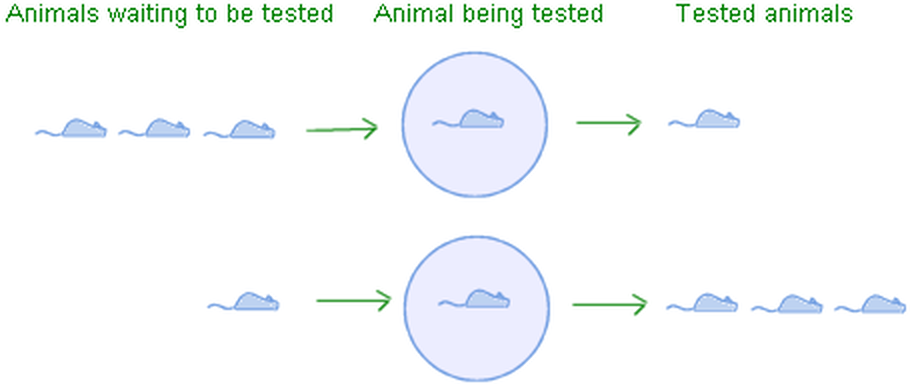
Figure 1. Animals 'pre-assigned' to two water-mazes.
While this simple assignment system seems very logical, it might be rather inefficient if tests can last for unequal durations and/or you are using some stage end rules. In these cases, it's possible for all the tests to end in one piece of apparatus while there's still a queue of animals waiting to be tested in another. To avoid this, you can choose to assign animals to the first available piece of apparatus. In this case, you won't know beforehand which piece of apparatus an animal will be tested on; it will just go to whichever one is free when its turn to be tested comes round - see figure 2.

Figure 2. Animals being assigned to 'the first available maze'. This makes more efficient use of the mazes, although it can lead to an 'unbalanced' experiment with more animals being tested in one piece of apparatus than the other.
In most cases where a protocol consists of more than one stage, you will probably want to ensure that an animal which was tested on one particular piece of apparatus in the first stage is tested on the same apparatus in all its subsequent stages - ANY-maze includes this option too.

© Copyright 2003-2026 Stoelting Co. All rights reserved
ANY-maze help topic T0390