ANY-maze Help > The ANY-maze reference > The Protocol page > The elements of a protocol > Testing > Stages > Options that affect all stages
Options that affect all stages

Introduction
Normally ANY-maze will perform all the trials in a stage, for all the animals in an experiment before moving on to the next stage, however there are two options (accessible from the Stages item in the protocol) which you can use to alter this behaviour.
| • | Completing all stages for each animal before starting the next stage |
| • | Not waiting for all animals to complete a stage before starting the next stage |
Completing all stages for each animal before starting the next stage
This option will alter the order in which animals are tested, such that each animal will progress through all the stages in the experiment, before the next animal starts being tested. Figure 1 shows how this would appear in the Test schedule report.
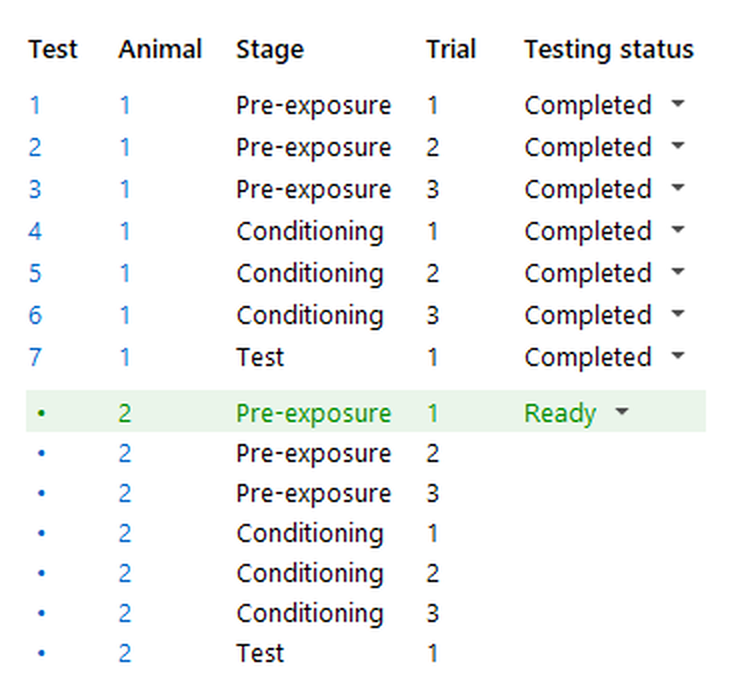
Figure 1. Here animal 1 has completed all the stages in the experiment and now animal 2 is ready to start being tested in the first stage.
Not waiting for all animals to complete a stage before starting the next stage
Usually ANY-maze won't move on to the next stage in an experiment before all the animals have completed all the trial in the current stage. For example, in a water-maze experiment you might have a Training stage, consisting of up to 8 trials, and a Probe stage consisting of just a single trial. As animals complete their training they could progress to the Probe stage, but ANY-maze will wait until they have ALL finished training before any of them move to the Probe stage. In practical terms this means that you'll either be running Training trials, or Probe trials, but not a mix.
However, this may not be what you want. For example, it might be that the animals complete training when they satisfy some sort of criteria, such as finding the platform within 30 seconds in two consecutive trials. This would mean that different animal will receive different numbers of training trials, for example one animal might have 5 training trials, while another might have all 8. Let's assume you train the animal once per day, so after 5 days the first animal has completed training but the other animal will take 8 days until it is trained. As you will only start the Probe trial once all the animals have completed training, this means that the first animal will have a 3 day gap between completing training and its Probe test, while the other animal will only have a 1 day gap.
To address this, you can tell ANY-maze not to wait for all the animal to complete a stage before moving on to the next stage, so then the first animal in our example would have moved straight on to the Probe trial, even though the second animal was still in the training stage. Figure 2 shows an example of the Test schedule report in this scenario.
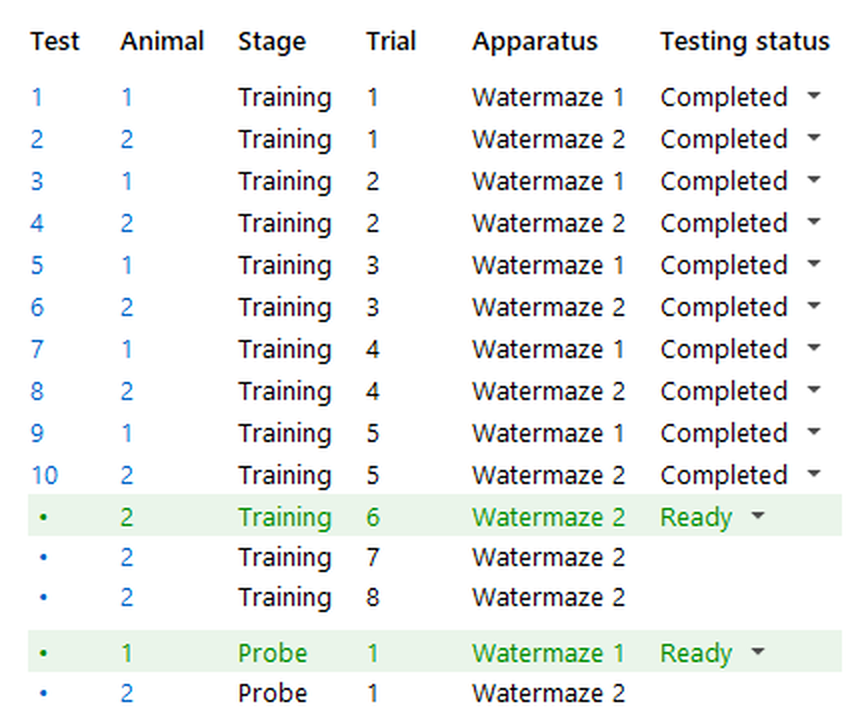
Figure 2. Here animal 1 has completed training after 5 trials, and is ready to be tested in its Probe trial, while animal 2 is still being trained.
See also:
| • | An introduction to stages |
| • | Setting up a stage |
| • | Creating stage end rules |

© Copyright 2003-2026 Stoelting Co. All rights reserved
ANY-maze help topic T1401