ANY-maze Help > The ANY-maze reference > The Protocol page > The elements of a protocol > Inputs and outputs > Signals > Setting up a signal > Setting up a filtered signal's baseline
Setting up a filtered signal's baseline

In brief
A filtered signal's baseline is generated from the values it has during a 'baseline period' at the start of a test. This period starts when the test starts and ends either after some specific period (for example, 30 seconds) or when something happens in the test (for example, the animal enters a specific zone).
If you chose to set up a baseline (it's optional), then you will also need to specify what is considered to be a Deviation from the baseline. This will be something like 'a change of more than 10% from the filtered signal's average value during the baseline period'.
Armed with this information, ANY-maze will then report a range of measures relating to the filtered signal and how it changes in comparison to the baseline during a test.
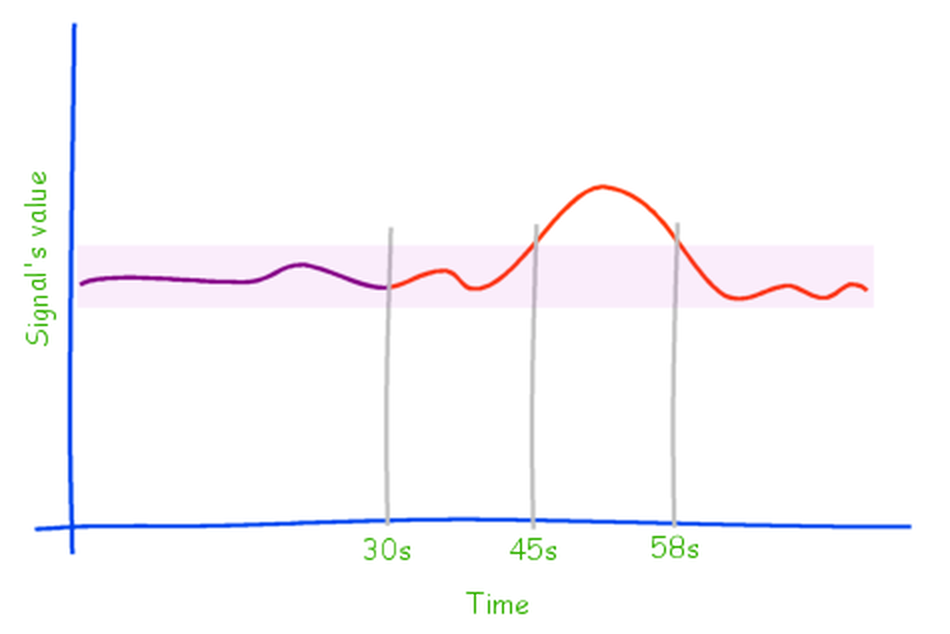
Figure 1. Here the baseline period is 30s, and 'deviation from the baseline' is defined as 2 standard deviations of the filtered signal's value during the baseline period - this gives rise to the shaded rectangle, which shows the baseline region. At 45s, the filtered signal deviates from the baseline and at 58s, it returns to it.
Details
The first part to setting up a baseline is to decide what will end the 'baseline period'. This is a the period during which the filtered signal's value will be considered to be the baseline. This period can either end after a specific duration, or it can end when something happens in the test; for example, the animal enters a certain zone.
| • | To end the baseline after a certain period of time, you simply need to check the box Baseline is the signal's average value until the following time in the test, and then enter the time in the relevant field. You can enter any value from 100ms to 10min. As is the case with most times in ANY-maze, you can use units of ms (milliseconds), s (seconds) or min (minutes) and you can mix units or use decimals, for example, you could enter '1min 30s' or '1.5min' or '90s'. |
| • | To end the baseline when something occurs in the test, you will need to create a procedure which will determine when the specific situation arises and will then use an Action to set a Time marker. You should then check the box Baseline is signal's average value until the following time marker, and choose the relevant time marker in the drop-down list. |
Whichever method you choose, the baseline will cover a certain period at the start of the test, and ANY-maze will average the filtered signal's value during this period and also calculate the standard deviation.
The second part to setting up a baseline is to specify what will be considered a 'deviation from the baseline'. Here, you will be defining how far from the baseline's average value the filtered signal will need to go for a 'deviation' to have occurred. For example, if the baseline's value was 10 and deviation was set to 10%, then if the filtered signal went above 11 or below 9, it would be considered to have deviated. Note that a deviation above the baseline is termed a 'positive' deviation, while a deviation below the baseline is a 'negative deviation'.
You have the following options for specifying the deviation:
| • | A certain number of standard deviations. Here, the standard deviation is the standard deviation calculated for all of the filtered signal's values during the baseline period. For example, if the baseline's average was 10 and the standard deviation was 0.65, and you specified that a deviation is 2 standard deviations, then ANY-maze would consider a positive deviation to have occurred if the filtered signal goes above 11.3 and a negative deviation if it goes below 8.7. |
| • | A certain percentage of the filtered signal's average during the baseline period. |
| • | A certain number of volts. Here, ANY-maze will convert the number of volts to whatever units you are using for the source signal (if any). For example, if you specified 0.01 volts and the source signal is being generated by a temperature sensor which generates a voltage of 10mV/°C, then 0.01 volts would equate to 1°C. If the filtered signal's average during the baseline period was 24°C, then a deviation would occur if the filtered signal went above 25°C or below 23°C. |
| • | A certain number of whatever units the converted source signal uses. For example, if the units of the converted signal are mmHg and you enter 10, and the filtered signal's average during the baseline period was 130mmHg, then a deviation would occur if the filtered signal went above 140mmHg or below 120mmHg. |
Baseline measures
If you set up a baseline for a filtered signal, then ANY-maze will report a range of measures that would otherwise not be available. The full list can be found in Signal measures.

© Copyright 2003-2026 Stoelting Co. All rights reserved
ANY-maze help topic T0166